Monday, August 28, 2017

Lake Bohinj, Slovenia: Bathing Suit or no Bathing Suit


That was the question as I prepared to leave Ljubljana, Slovenia for a day at Lake Bohinj. 


Most tourists go to Lake Bled but I wanted to head right for wilderness. It is part of the Tiglav National Park.  Should I pack the bathing suit and towel in order to swim, assuming I could find a way to safe-guard the day-pack while I did? What a hassle it is to not have a car or at least a friend to help!

So, I decided to pack light and just walk the wild path around the famously beautiful lake.


I could climb the canyon! Climb beside the water-fall! Have a perfectly marvelous time without swimming… I told myself. Besides, what if the lake was dangerously cold? After all, I had almost collapsed of hypothermia while circumnavigating the waters of Pray Lake in Montana before my concerned partner, Andy, had hauled me out.

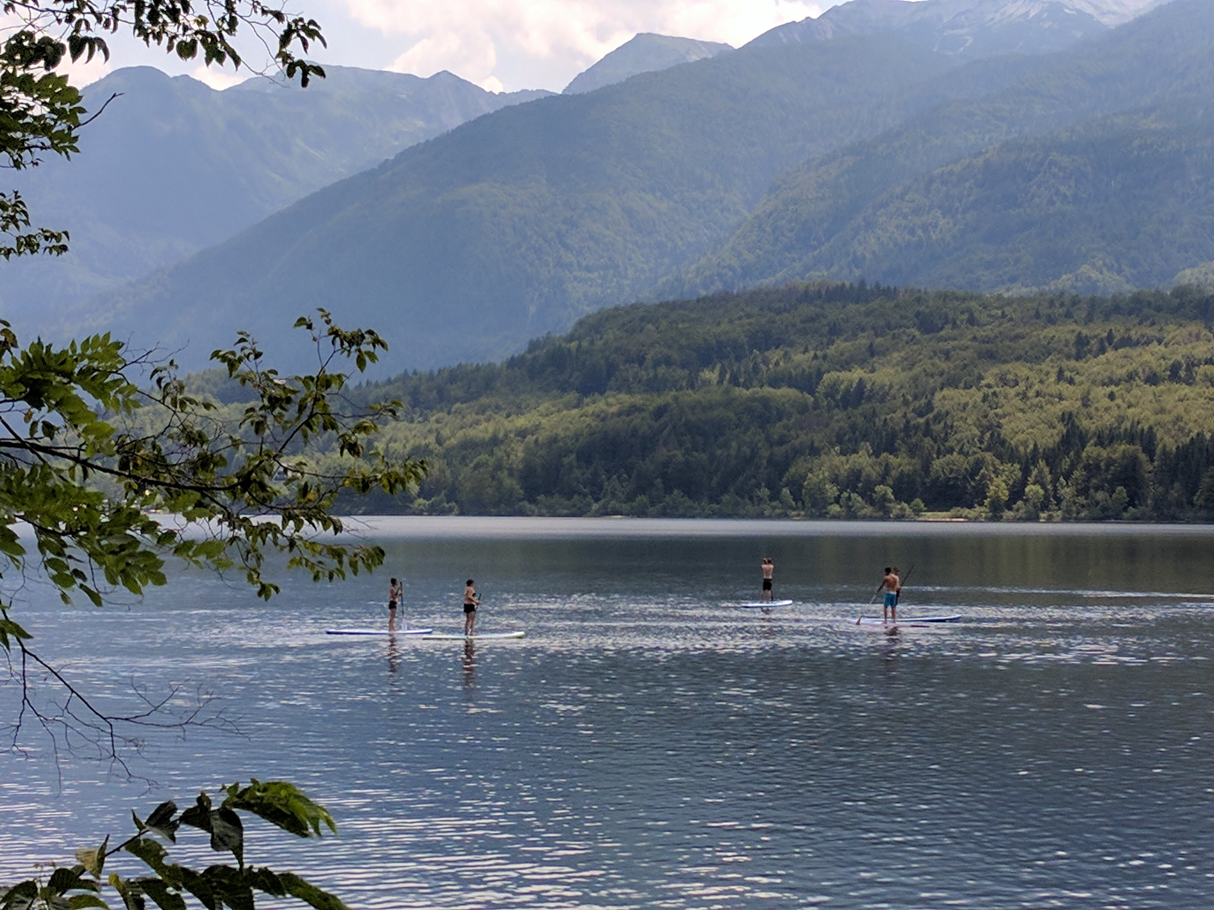
But the minute I saw the lake I knew I’d made the wrong decision. It begged it be entered! Look at these happy kayakers!


These paddle-boarders


These gleeful children and relaxing families! The purpose of Lake Bohinj is to be on it or in it! Sure I could see the one local sight of the 1300 AD Church of St. John the Baptist. Especially interesting was his wooden head.


And I could admire the strikingly white limestone boulders along the path. 


And try without success to find the path to the canyon. (Tourist-office guides aren’t always helpful – “Go to the right a little and then try to find the unmarked path in the meadow.”)

The further I walked, the fewer the people and the less the clothes. 

And the more the waters beckoned. They were almost Caribbean in turquoise color with white sandy bottoms – because of the lime-stone. What to do??? Finally I noticed two young women off-shore, looking suspiciously like they could be skinny-dipping. I waited and watched hopefully unobtrusively until they emerged. And yes! Apparently at this distance from the main beach the Slovenian etiquette is that it’s OK to have no bathing suit! But was I brave enough? I explained my shy dilemma to them and like daughters encouraging a cowardly Mother they said, “Just do it!”

So, I did it.  Sort of. 


Down to the underlying sports bra and  black underwear that sort of looked like a bathing suit. I boldly sat in Lake Bohinj. Actually there was no need to do more. Just talk to these fine young women who are working with “asylum seekers” in Germany. And finally when refreshed by the clear cold waters I stumbled out, they lent me a towel and kept a look out so I could change out of the wet clothes.

I don’t really know the point of this story. My timidity?  Depending on the help of others? A baptism of sorts? Or just the knowing that you have to do what you have to do. 
Next time? Pack the bathing suit!


8-24 Montana … or Slovenia?

Once again I was totally ignorant about a country. 

Yes, I had been to Yugoslavia in 1969 while traveling the world on the International Honors Program. And yes, I had heard that the country had fallen apart in the 1980’s after Tito’s death and that after struggling with ethnic wars and desires for independence had emerged into seven countries. I’d already enjoyed one of the poorer ones – Macedonia – and was about to partake of a richer one, Slovenia. Why? Because  Eva I met while gardening in Bulgaria was from Ljubljana, Slovenia  and the name just sounded too cool to miss. And because Cisco and Cat from Canada had told me of a conference to be held in Maribor, Slovenia. Sign me up!

So, I emerged from the airplane in Ljubljana, looked around and was convinced I’d landed in the mountains of Montana (actually that's what a local told me, getting off the plane.)


A  capital city, yes, but surrounded by forests, streams, lakes and mountains! And as I left weeks later I swore I would return. 

Ljubljana… isn’t just the name itself enchanting? 

I’m almost reluctant to share my enthusiasm out of fear that hordes of tourists will clog the medieval streets as they are in Prague. Maybe this is the new Prague? It surely is just as beautiful. And because it is smaller much more walkable and manageable. I could find my way to the gardens and not get lost, like I had in Prague.


If you go, take a walking tour. Take three walking tours like I did! The Medieval Tour reveals living habits and sights, including the hang-man’s house and the always visible castle. The Communist Tour dispels any illusion that Tito was a just nice guy. He was better than Stalin of course, and protected the conglomeration of areas that he called Yugoslavia from Russian control but he still tortured and murdered his perceived opponents.


And then just wander by yourself and be amazed at the beauty. 

Why is this place so special? Well, it was here that Perseus of the Golden Fleece, with his Argonauts,  killed the defending dragon and found his way back home. Its churches were never destroyed by the Turks – somehow it defended itself from those marauding invaders who captured little boys and turned them into janissaries. The swamps were drained and channeled into a managed river, now lined with cafes and music. (Although it is said that a dragon still guards the city!)


It is a very livable, safe and apparently happy city. 

The down-town is free of cars. Instead of dodging traffic, people walk, bicycle, and use scooters and wheel-chairs. Really! If I had to travel without legs this is where I would use my arms to navigate! I even saw a bicycle wheel-chair in which the lady was using her arms on pedals out in front of her to zoom along! Outside of down-town there are bicycle paths, bicycle traffic signals and slopes beside stairs, for bicycles. 


It is a playful place – see the downtown mist installation. 


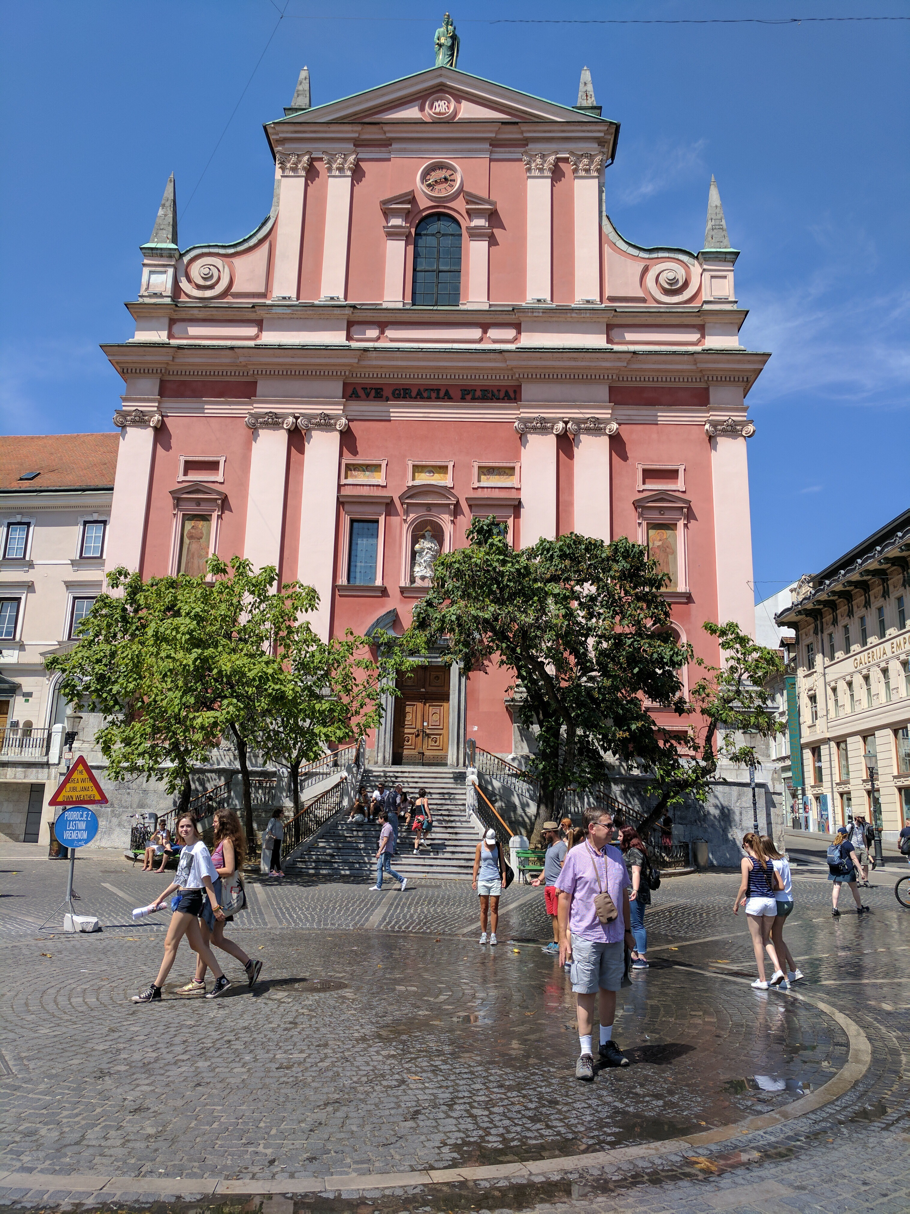
See the lyric poet France Preseren gaze longingly across the square at  his unfulfilled love, Julija. (And his muse above, whose breasts were discreetly hidden by trees from the church goers.) 


Enjoy walking by the river and special briges day and night,


And enjoy Tivoli Park just out-side the down-town where families lounge on the grass, picnicking and listening to music.


But the real reason I would encourage you to visit is the architecture and city design. 

Google the Sloven architect Joze Plecnik,  who also worked on the  Prague Castle,  parts of Vienna and Belgrade and of course his home town. He built  buildings and embankments, churches and a cemetery and so much more. His design gives this special city a unified sense of beauty that I have never seen in my travels. 

See his National Library that looks like a Turkish rug, woven from bricks. The inside is constructed to lead you from the darkness of ignorance to the brightness of enlightenment!  


And this Triple Bridge, adapted for vehicular and pedestrian traffic. None of this was destroyed in the war. And no Communist concrete ugliness mars the old elegance. 


And once you have explored every nook and cranny of magical Ljubljana, protected by its dragon,


  ... take a bus to the surrounding countryside and understand why you could mistake it for … Montana!


The Third Pearl of Macedonia -- Forgiveness


I have been haunted on this trip by an unresolved issue.

A person who hurt me, I thought, and who acts like I hurt him. No amount of wandering and diversion, no number of sights and foreign languages have erased this solid lump of anger/sadness.

Will I find the answer here in Lake Ohrid? I’ve learned to not judge so much (see Pearl One) but yet the pain that guards the heart won’t let in the love that connected us.

What will be the final pearl? 


Everywhere they seem to be hawking Ohrid pearls! Apparently they don’t come from oysters but are some mysterious concoction from the scales of the Plasica fish in the lake. Repeatedly I hear that only two special families know the secret and that all the others are fake. Hence my focus on true wisdom and not glib answers.

And what is the attraction of this lake, the focus of our 5 day Macedonian tour?


Lake Ohrid has yet to be discovered by most tourists. Yay!!! In 700 BC it was inhabited by those who built houses over the lake on over 6000 piles. A reconstruction called “Plocha Mikov Grad” resembles the description by Herodot. One can only imagine the attraction to the bountiful fish and fowl here. 

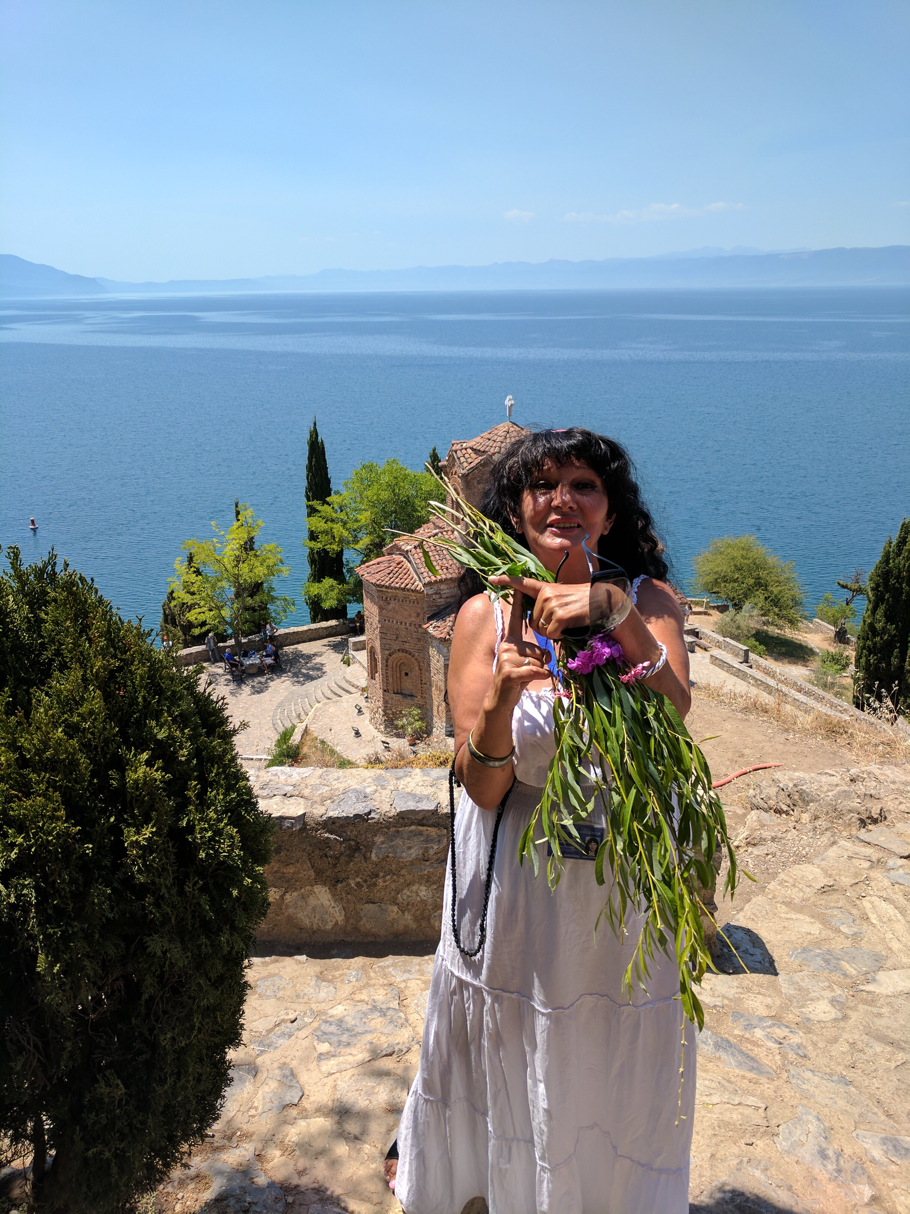
It has been the destination for centuries of political leaders (Alexander the Great probably. Tito had a home there.) It has been the sacred place of Christian teachings, monasteries, and pilgrimage sites. I can’t even remember all the names of the churches we visit, much less the significance of the number of cupolas each has. St. Naum’s monastery contains his body and we are instructed to lay our ear over the concrete cover and listen for his heart. When I try to find out the name of the “Church in the Rocks” we visit, Wikepdia says is one of many churches in the rocks around the lake! Lake Ohrid is surrounded by the sacred.


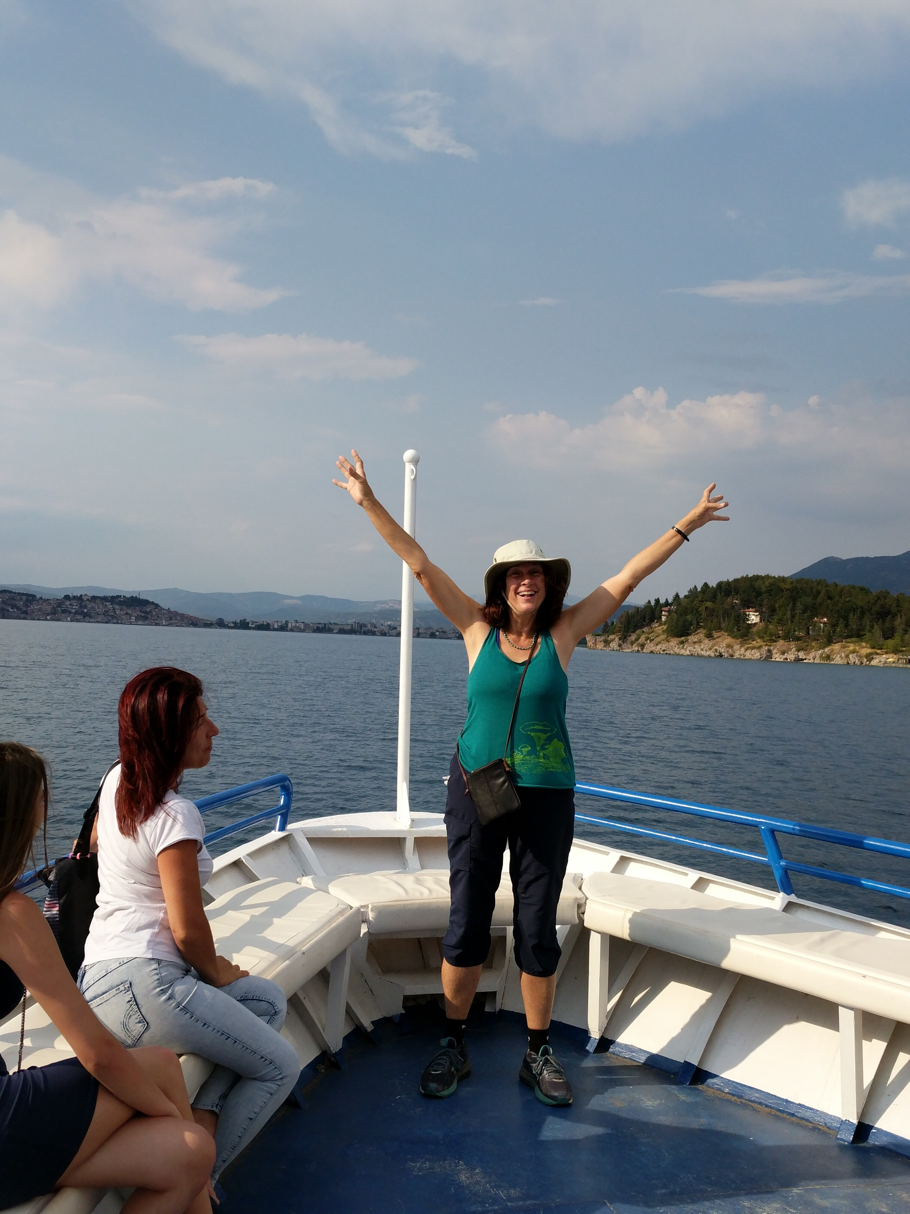
The skies change their light continually. Indeed the ancient name was Lychnidos, “City of Light.” A boat ride in the lake yielded spacious photo opportunities of changing patterns and unfolding vistas, each more “picturesque” than the previous.


The sacred, the light … and the water! Ahhh… the water. 

That’s the attraction to Ohrid! That’s why the conquerors sought Macedonia! Witness the origin of much of the flow from numerous springs at the Monastery of St. Naum. They resemble the hauntingly beautiful springs in Northern Florida where I have kayaked and camped. Symbols of a spiritual source indeed, coming from the depths in a trust-worthy continual gushing flow.


https://youtu.be/B-PZFizucWA

This is an ancient lake, formed 2-3 million years ago. And because of the surrounding mountains a unique collection of plants and animals have evolved. It does feel unique and special. The lake is vast, mysterious, and deep. The water is clear and beckoning. It is primarily the Eastern Europeans who flock to its shores. Happy happy people! Something about the basin of blue-green held by the arms of forest and rock.


I don’t really associate with my friends here, just wander the ancient sites and ask for answers. 

Most of the churches are closed but one is open, the famous St. Sophie. Ancient, beloved, abused by the Moslem reign, restored with surprise as frescoes were uncovered, used for concerts because of its perfect acoustics. St Sophie. Well, I guess this where I am supposed to be after all, un-distracted by lectures or companions.


I wander its old naves. Wonder at the dulled painted figures – so many important men, popes, apostles, martyrs … It must have been absolutely glorious! A historical and Biblical story-book on ever wall, for those who of course couldn’t read. 

I’m supposed to be here. Of all the places, all the streets, all the lectures, this is it. “Is there an answer,” I ask? And opening my eyes, am shown. In the upper center of all these glorious, learned and heroic men she sits. The simple Madonna holding what looks like an oval platter. Containing of course her child, the Christ. Unadorned. Simple. Holding the answer.


The PhD guide had alluded to it. “Christ,” she had pronounced, waving flowers, “Is about love, forgiveness, understanding, trust…”

So here us the highest answer to my suffering and to that of the world.

I like visual answers! The feminine holding onto the Christ. Whether or not one calls oneself “Christian”, a powerful message of the New Testament is about forgiveness. Blanket forgiveness because we are all human and we all screw up.

As we know forgiveness is a process, over and over and over again.It is a very high intention. And it takes courage and clarity and help. So on the final day at Lake Ohrid I dive into the cold cleansing waters and do just that. Immersing myself probably  in the very blood, sweat and tears of the saints, I forgive him. And I forgive myself. And I ask for daily help to do what is best.


I’m leaving Macedonia with the final pearl. And actually laugh about the whole pearl thing! 


I’ve asked everyone from tour guide to hotel clerk what defines the “true” Ohrid pearl and the “fake” ones that are pawned off on tourists. The young lady in the expensive pearl shop owned by one of the two special families tells me the truth. “The true Ohrid pearl is layers of emulsion on top of a form we construct from abalone shell. The false Ohrid pearl is on some other base – it could be plastic!” Really? They are all fake anyway since they aren’t from oysters!

 Does it really matter I think? Underneath we are all so flawed! The only answer is to daily lay down new precious layers, new patterns, formed of suffering and wisdom, questions and answers, ever-changing patterns of dark and  light,… and let all the pain dissolve with intention in the boundless and continually renewed waters that, after all, connect us.

(Post-script: And I never tell him this. I just become clear about my own boundaries. And reach out in love to form an evolving genuine friendship.)

                                 My Ohrid Pearls from the shop recommended by the tour guide (probably a cousin) -- $30


Thursday, August 24, 2017

Pearls of Macedonia: Pearl One -- The Vow


“Where am I going and why?” I asked myself on the 9 hour bus ride. 

A 5 day, 4 night bus tour to Macedonia from Bulgaria, all lodging and most food for just $175 --- sign me up! Inexpensive and exotic- sounding.

“Where in the world is Kathy now?” I could hear my friends asking. Macedonia! "And where in the heck is that?" I was about to find out. Never mind that the tour was in Bulgarian. Sure I missed the history and descriptive facts, sometimes for hours at a time as the guide lectured.  Rather than be frustrated I decided to gather impressions. And to look for the pearls of Macedonia.


This relatively poor area that became a country after Yugoslavia dissolved has been sought and conquered for thousands of years. Alexander the Great is its most famous son. It has changed hands in battle countless times. Greece is still upset by the name Macedonia and has demanded they change their rising sun flag. Why? I wonder. Why is Macedonia so desirable?

Mountains, forests and some agriculture whizzed by on the bus ride and I hoped to answer those questions in Ohrid, the destination. 

But first was Skopje, the capital. 

Devastated in an earthquake it now sports marble bridges, marble fountains and marble sculptures. On one side of the river is the old town – Muslim with minarets. The Turkish baths have been turned into art galleries. 


On the other side, the new.


We were allowed one hour to sight-see after the walking tour in Bulgarian so I headed for the Holocaust Museum. 


Why? To determine if the Jewish situation in Macedonia was the same as in Bulgaria. Apparently the Bulgarian King and Church kept putting Hitler off when he demanded their Jews, appeasing him for awhile by donating some Jews from the outlying areas. No actual Bulgarian Jew died. What happened in Macedonia?

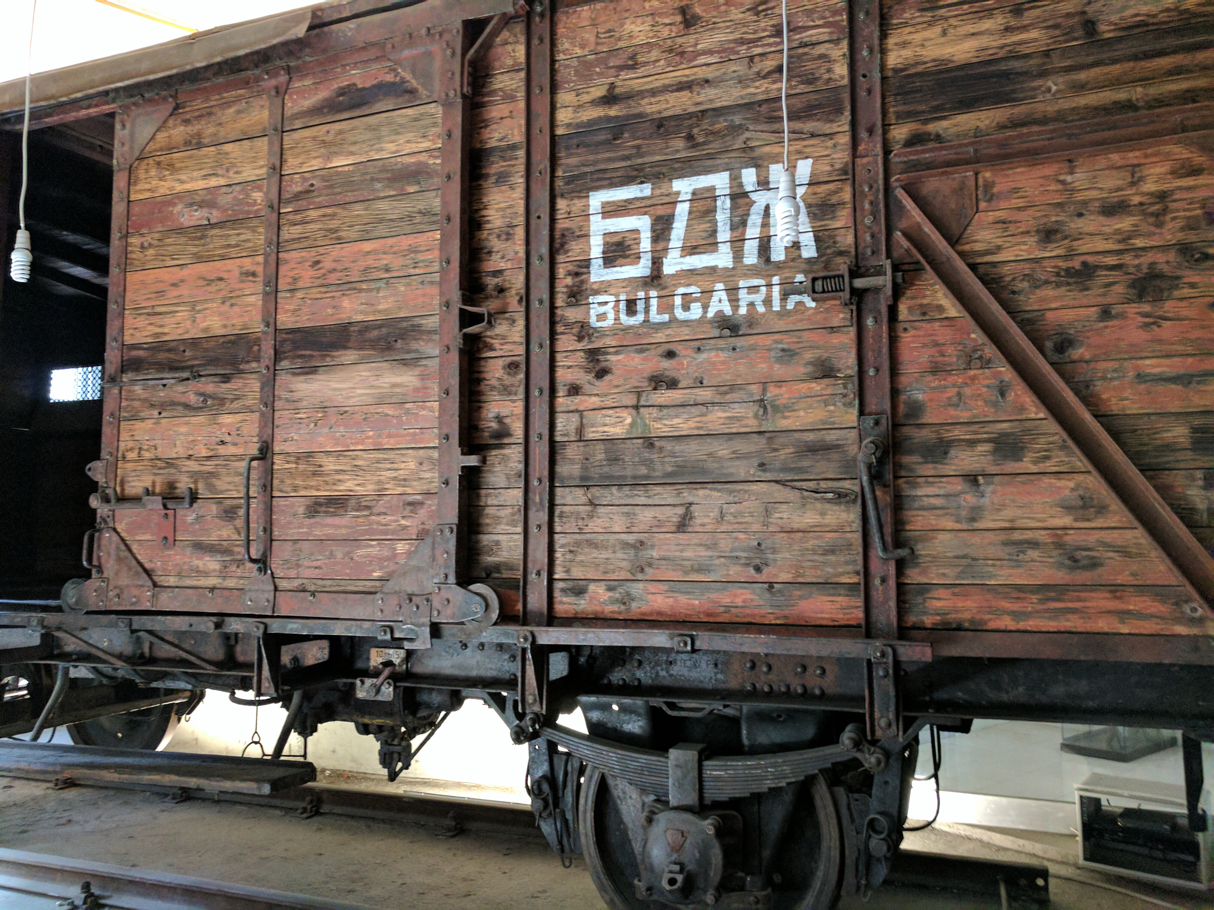
When I questioned the guard about the Bulgarians’ kindness to Jews, he just laughed and pointed to a room that was occupied by a cattle car. One that had been the horror transport to Treblinka for Macedonian Jews. On its side were the stenciled ownership of the car– “Bulgaria.” 


Tentatively, like approaching a graveyard or gallows, I touched it. The smoothed -from-wear wooden threshold which was the last taste of Macedonia for hundreds. The airless dark interior that surely stunk of urine and fear. We’ve all read the stories and seen the movies and uniformly hate Hitler. I’ve been to Dachau and seen the barracks and pictures. But there was something more real and urgent about this cavernous-mouthed structure. 

And rather than hate Hitler even more or wonder at the complicity of citizens, I made a personal  vow.

And please help me keep it! I decided to look at the underlying cause of intolerance and even violent thoughts – inside myself. Making a person, a whole group of people, a religion, a country -- “Other”. What drives us to do that? I know that I can “kill” someone with my thoughts, load them into a cattle car by my judgement and push them far away. (Note my careless blog references to "gypsies" or "corrupt politicians.") Why? Fear? Arrogance? Self-protection? Perhaps even the pleasure of judgement? 

And right then I decided to not do that anymore! To not contribute to the violence of the world by my thoughts and to cultivate peace. It sounds trite, doesn’t it? Don’t we all want peace? But even in Skopje there were instant challenges to this new vow! A Muslim man disregarded us thirsty women at a fountain as he took his time doing his ritual cleansing. A gypsy beggar boy annoyingly ran after me. 

But there was also inspiration!

Mother Teresa was born in Skopje, preached the family-hood of all humans and cared for the dying of all religions. In modern Skopje now marble fountains of women arise from the earthquake’s rubble. 


And mosques live peacefully with Orthodox churches.


This cattle car with “Bulgaria” boldly written on it, the horror of group discrimination in my own mind and the vow to not put anyone out of my heart -- this was my first pearl from Macedonia. I looked forward to more.


Monday, August 21, 2017

The Second Pearl of Macedonia -- Hospitality


If the first pearl from Macedonia was the vow to not reject whole groups of people (and I will try folks! Notice how I’m no longer referring to corrupt governments or ethnic groups that beg), what is the second take-away?

This is a poor country. And yet it has been sought for centuries, fought over, desired. Why? My persistent questioning of tour guides, clerks and chefs has only yielded this – that Macedonia, poor in resources, difficult to traverse because of mountains, is the gateway through which armies must pass in their conquering fervors.

I can accept that historical perspective but have to look deeper for my personal pearl. What am I to find in Macedonia?

It is the people. In their struggles, in their passion for beauty, in their ethnic pride, in their hospitality… it is the people.

I don’t have many pictures of them – it is less invasive to photograph statues or roses. But they have left in my heart that warm glow of “welcome!”
And be sure to watch the happy videos below!

“Welcome” from the hotel clerk who appeared to do everything – carry my luggage, lay out breakfast, put a table cloth under my coffee cup when I sat at the wrong table, clear the dishes, answer my requests – without speaking English. And from those who did speak English, the willingness to happily arrange my taxi to town ($2), apologize for wi-fi not reaching the third floor, and showing me on the map how to get to a concert.

“Welcome” from the clerk at the Ohrid Summer Festival office as she patiently described each offering, where in the labyrinthine streets it was held and sold me tickets.

“Welcome” from the ticket taker who gave me the key to the the hole-in-the-wall toilet at the out-door ballet performance and handed me toilet paper. (And tried to ask me out for a drink after the show. No go!)

"Welcome" to the children who were invited up front at the performance's end and to us in the audience who danced.


https://youtu.be/iGes5QhYgQQ

“Welcome” from Tanya, the owner of my favorite restaurant, who when I said I wasn’t sure I had enough cash to order dinner on my second visit, said – “You have enough! For you, it doesn’t matter!” (At my first meal she had drawn on the map how to get to the Festival box-office and was glad to hear I had gone.) And proceeded to patiently tell her new cook, as I peered through the window, how to grill the zucchini, mushrooms and pita. Here is the marvelous dinner she concocted, adding her home-made “curd” and other asides. It probably cost $5.


"Welcome" from the waiter who let me nurse a glass of orange juice for an hour while I just gazed and wrote.


And ”Welcome" from the local tour guide, who kindly translated her Bulgarian lecture to English for the four of us. Ohrid is gorgeous -- ancient and special. 


This is her country, her beloved town of Ohrid, her history that she passionately shared. With a PhD and book to her name, she barely received living wages and wanted to decline my tip. “You deserve it! Thank you so much for sharing!” I insisted.

I don’t know if the armies were welcomed in as they traversed this land. I do know that after the dissolution of Yugoslavia there are still the problems of no jobs, old age security or trust-worthy you-know-you’s. I am so grateful, however, that on my last night in Ohrid I happened upon a stage and dance-troupes from surrounding ethnic groups. Muslim and Christian. Young and old. From Macedonia, Bulgaria, Kosovo and Turkey. Someone moved over to let me sit on a rock and to join the mighty “Welcome to all!"

Enjoy their ehtnic and all-inclusive joy my friends!


https://youtu.be/zDYtNly0G3o


https://youtu.be/n60QTbbqErA


https://youtu.be/ra4CNIl2TCU


The pearl? That is doesn’t take money, just heart, to make a stranger feel welcomed!


Enriched by Bulgaria!


I’m leaving Bulgaria. 

Even though it has only been a few week,  it feels like home. Of course there were a few cultural items to master:
  • I can finally calculate with their money. 
  • I intellectually know that the head waggle side to side means “Yes” although in the shops I get fooled and almost walk out when I’ve asked for something and they seem to say “No.” 
  • I know the many delicious offerings that on the menu and the  others may or may not be interesting—pig ears, veal tongue and tripe soup. 
  • I’ve learned where you have to buy water – parts of Sofia are not safe—and where it is cold and sweet from the mountain springs (below).
  • And I know how to get a massage – top off, bottoms on. 


Communication can be challenging but doable.

I’ve given up trying to learn any words because I’m a visual learner and the written language is Cyrillic. Well, I mastered four words actually– “Yes, no, good day and dog.” Why “dog?” Because the 17 year old practicing English on me on the three hour train ride insisted on it. I failed at “cat, rooster and rabbit” but “dog” I got because it vaguely sounds like “poochie.”

And I no longer nod my head at all! A sort of yes sign is mistaken to mean that I understand what they are talking about and that’s not a helpful assumption because the one-way conversation goes on and on. An American “No” is mistaken as a “Yes,”and then I really get into trouble!

When in doubt, body language works. The shop clerk Maria told me with gestures and one word that her uncle died in Denver.

Numbers also work. Written out for our age. Cash register print-out for what I need to pay. (Always ridiculously little.) And when I had to pick out compression stockings for my poor left calf which wasn’t happy with prolonged sitting (two months after knee surgery), metric language worked. She just got out the tape measure and I ended up with the perfect size.


And now that I’m leaving for Macedonia and Slovenia I look back as the train races through the Valley of the Thracian Kings, the Valley of the Roses,  the fields of sunflowers and lavender and the range of mountains… and can truly say I have been enriched by Bulgaria. 

Is it an easy country?

Well, I could not have survived without my English speaking friends who arranged taxi rides, train rides, bus rides, spa days, hair appointments and general directions. But for the restaurants, pharmacy, grocery stores,  hotels and airports you would do just fine. Well, … getting “baby aspirin” was interesting. The pharmacist said – “We don’t give aspirin to babies in Bulgaria.” I pointed to the bottle that had an EKG on it and got the right dose. (But pointing to the hair swatch in the hair-dresser was a little dicey.They thought I’d look better as a red-head!)

Bulgaria is a relatively financially poor European country.
My friend Anita who was responsible for inviting me here, came with the Peace Corps. Japan has donated to the town of Kazanluk. Occupied by the Turks, controlled by the Communists and then bankrupted when the Iron Curtain fell and industry collapsed … it does lack infra-structure and jobs. With the hard times people stopped having babies and are now encouraged to even take out loans to get in vitro fertilization. (Witness the number of twins a few years ago when two eggs were implanted for efficiency sake.) 

The pensioners are struggling. The young keep leaving for work. A delightful medical student who indulged my train ride of questions claims he can not afford to get specialty training and practice in Bulgaria. He won’t have any student loans to pay off but his parents would have to continue to support him as he worked as a doctor.  Never mind having a family! So, he is learning German for his eventual destination. Dessie, our Bulgarian angel who arranges everything, told me that in order to have elective surgery that might require transfusion, the patient’s family has to personally gather 20 blood donors. If not enough family is available then – pay the gypsies!

Is it safe? Yes – I walked the streets alone at midnight. Of course you watch out for the dishonest taxi drivers. And of course you don’t trust the politicians, but do you ever? Here corruption is more overt than in the US – votes are conspicuously bought by bussing in gypsies after falsifying their residency in a locale.

But other than the above inconveniences, which can be managed, I love Bulgaria!!! 

“What is your true wealth,” I asked a train companion. “Nature!” 

I agree. Mountains of trees, cascading streams, springs feeding the villages and gardens below. So much land that was owned communally in the communist times is owned by the government now and unused. There is an abundant diversity of natural life!The English entomologist who came to do surveys for the Balkan Ecology Project in Shipka was amazed at the species of insects he captured and took home for identification.”Some of them have never been identified!” And the birds and lizards and jackals… 


I especially love how the yards are relatively unmanicured. Often weeds grow and are cut to provide mulch. Wildflowers and grass amongst the roses. 


This place loves roses! Witness the embroidered roses in the ancient garb. The rose oil distillery in Kazanluk. 


And the fruits and vegetables!  Salads start the meals -- usually of tomatoes, cucumbers and grated cheese. Eggplant, zucchini and onions are cheap. And apricots! (I offered the vender a dollar’s equivalent in the open market and had to stop her after 50 cents worth!)


I swear that everyone in a village has a garden of edibles – it is just standard and probably was a matter of survival. Canopies of grapevines. And fruit trees that line the streets, dropping snacks on us below. Who cares if the sidewalks get stained with cherries and mulberries! A guard at a museum told me of his cherry orchard in the country and how of course a child in the city should be able to walk outside and reach up for a cherry. “This is how children should be raised—natural!” 

And here is one backyard's fruit bounty.


The tourist industry would offer that the true wealth is the history. 

There are mound-like tombs everywhere in this valley, complimenting the mountains and interrupting planted fields.Thracian history 2500 years old and Neolithic findings 3500 years ago. A "Door of the Goddess" Megalith. Ceremony, ritual… resounds through the ages. And memorials to battles for independence.


But I would argue that the true wealth is the people. 

They were friendly and interested in me once I broke a little barrier by being interested in them. They were always kind and helpful (watching out of course for taxi drivers and politicians.) The above mentioned museum guard asked me to sit down as we chatted about child rearing and brought me a cup of tea with biscuits. People on the train offer food. I’m always directed to the WC whether I buy anything in the cafĂ© or not. I’m shown where to get compression stockings by the pharmacist who walks me part-way down the street.


Does this culture of helpfulness come from child rearing? I have to surmise from a distance. Children are few and are beloved. Proud parents parade prams in the park. There are playgrounds whenever possible as part of a restaurant. Parents tolerate children freely yelling in a tomb (why not – it reverberates) or interrupting an adult conversation. The children seem happy and the parents happy with them – I have never seen an angry parent here. The children dance wth their parents the horo or imitate the steps to the side. The teens sit in the parks at night, just hanging out in a healthy way. Indeed people seem to sit a lot in cafes for coffee or beer or to socialize. It feels communal and healthy.Teens talk to strangers on the train with no self-consciousness or sullenness. Wow!


I wish them a better time ahead and sincerely hope they don’t lose the sense of community, family life and certainly nature as they move more into financial security. And I leave, so much richer, and well-fed, for the experience. 


Thank you Bulgaria!