I’m leaving Bulgaria.
Even though it has only been a few week, it feels like home. Of course there were a few cultural items to master:
- I can finally calculate with their money.
- I intellectually know that the head waggle side to side means “Yes” although in the shops I get fooled and almost walk out when I’ve asked for something and they seem to say “No.”
- I know the many delicious offerings that on the menu and the others may or may not be interesting—pig ears, veal tongue and tripe soup.
- I’ve learned where you have to buy water – parts of Sofia are not safe—and where it is cold and sweet from the mountain springs (below).
- And I know how to get a massage – top off, bottoms on.

Communication can be challenging but doable.
I’ve given up trying to learn any words because I’m a visual learner and the written language is Cyrillic. Well, I mastered four words actually– “Yes, no, good day and dog.” Why “dog?” Because the 17 year old practicing English on me on the three hour train ride insisted on it. I failed at “cat, rooster and rabbit” but “dog” I got because it vaguely sounds like “poochie.”
And I no longer nod my head at all! A sort of yes sign is mistaken to mean that I understand what they are talking about and that’s not a helpful assumption because the one-way conversation goes on and on. An American “No” is mistaken as a “Yes,”and then I really get into trouble!
When in doubt, body language works. The shop clerk Maria told me with gestures and one word that her uncle died in Denver.
Numbers also work. Written out for our age. Cash register print-out for what I need to pay. (Always ridiculously little.) And when I had to pick out compression stockings for my poor left calf which wasn’t happy with prolonged sitting (two months after knee surgery), metric language worked. She just got out the tape measure and I ended up with the perfect size.

And now that I’m leaving for Macedonia and Slovenia I look back as the train races through the Valley of the Thracian Kings, the Valley of the Roses, the fields of sunflowers and lavender and the range of mountains… and can truly say I have been enriched by Bulgaria.
Is it an easy country?
Well, I could not have survived without my English speaking friends who arranged taxi rides, train rides, bus rides, spa days, hair appointments and general directions. But for the restaurants, pharmacy, grocery stores, hotels and airports you would do just fine. Well, … getting “baby aspirin” was interesting. The pharmacist said – “We don’t give aspirin to babies in Bulgaria.” I pointed to the bottle that had an EKG on it and got the right dose. (But pointing to the hair swatch in the hair-dresser was a little dicey.They thought I’d look better as a red-head!)
Bulgaria is a relatively financially poor European country.
My friend Anita who was responsible for inviting me here, came with the Peace Corps. Japan has donated to the town of Kazanluk. Occupied by the Turks, controlled by the Communists and then bankrupted when the Iron Curtain fell and industry collapsed … it does lack infra-structure and jobs. With the hard times people stopped having babies and are now encouraged to even take out loans to get in vitro fertilization. (Witness the number of twins a few years ago when two eggs were implanted for efficiency sake.)
The pensioners are struggling. The young keep leaving for work. A delightful medical student who indulged my train ride of questions claims he can not afford to get specialty training and practice in Bulgaria. He won’t have any student loans to pay off but his parents would have to continue to support him as he worked as a doctor. Never mind having a family! So, he is learning German for his eventual destination. Dessie, our Bulgarian angel who arranges everything, told me that in order to have elective surgery that might require transfusion, the patient’s family has to personally gather 20 blood donors. If not enough family is available then – pay the gypsies!
Is it safe? Yes – I walked the streets alone at midnight. Of course you watch out for the dishonest taxi drivers. And of course you don’t trust the politicians, but do you ever? Here corruption is more overt than in the US – votes are conspicuously bought by bussing in gypsies after falsifying their residency in a locale.
But other than the above inconveniences, which can be managed, I love Bulgaria!!!
“What is your true wealth,” I asked a train companion. “Nature!”
I agree. Mountains of trees, cascading streams, springs feeding the villages and gardens below. So much land that was owned communally in the communist times is owned by the government now and unused. There is an abundant diversity of natural life!The English entomologist who came to do surveys for the Balkan Ecology Project in Shipka was amazed at the species of insects he captured and took home for identification.”Some of them have never been identified!” And the birds and lizards and jackals…

I especially love how the yards are relatively unmanicured. Often weeds grow and are cut to provide mulch. Wildflowers and grass amongst the roses.

This place loves roses! Witness the embroidered roses in the ancient garb. The rose oil distillery in Kazanluk.

And the fruits and vegetables! Salads start the meals -- usually of tomatoes, cucumbers and grated cheese. Eggplant, zucchini and onions are cheap. And apricots! (I offered the vender a dollar’s equivalent in the open market and had to stop her after 50 cents worth!)

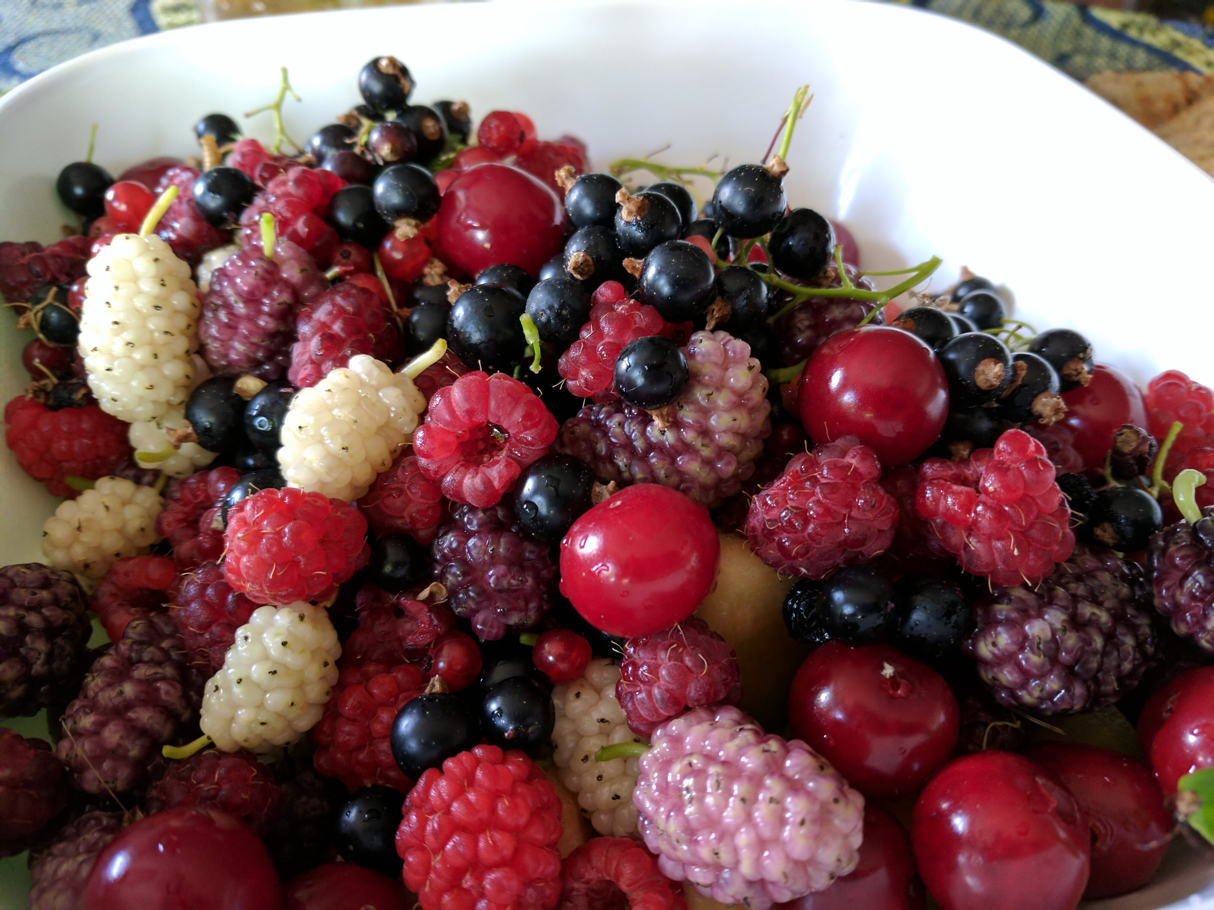
I swear that everyone in a village has a garden of edibles – it is just standard and probably was a matter of survival. Canopies of grapevines. And fruit trees that line the streets, dropping snacks on us below. Who cares if the sidewalks get stained with cherries and mulberries! A guard at a museum told me of his cherry orchard in the country and how of course a child in the city should be able to walk outside and reach up for a cherry. “This is how children should be raised—natural!”
And here is one backyard's fruit bounty.

The tourist industry would offer that the true wealth is the history.
There are mound-like tombs everywhere in this valley, complimenting the mountains and interrupting planted fields.Thracian history 2500 years old and Neolithic findings 3500 years ago. A "Door of the Goddess" Megalith. Ceremony, ritual… resounds through the ages. And memorials to battles for independence.

But I would argue that the true wealth is the people.
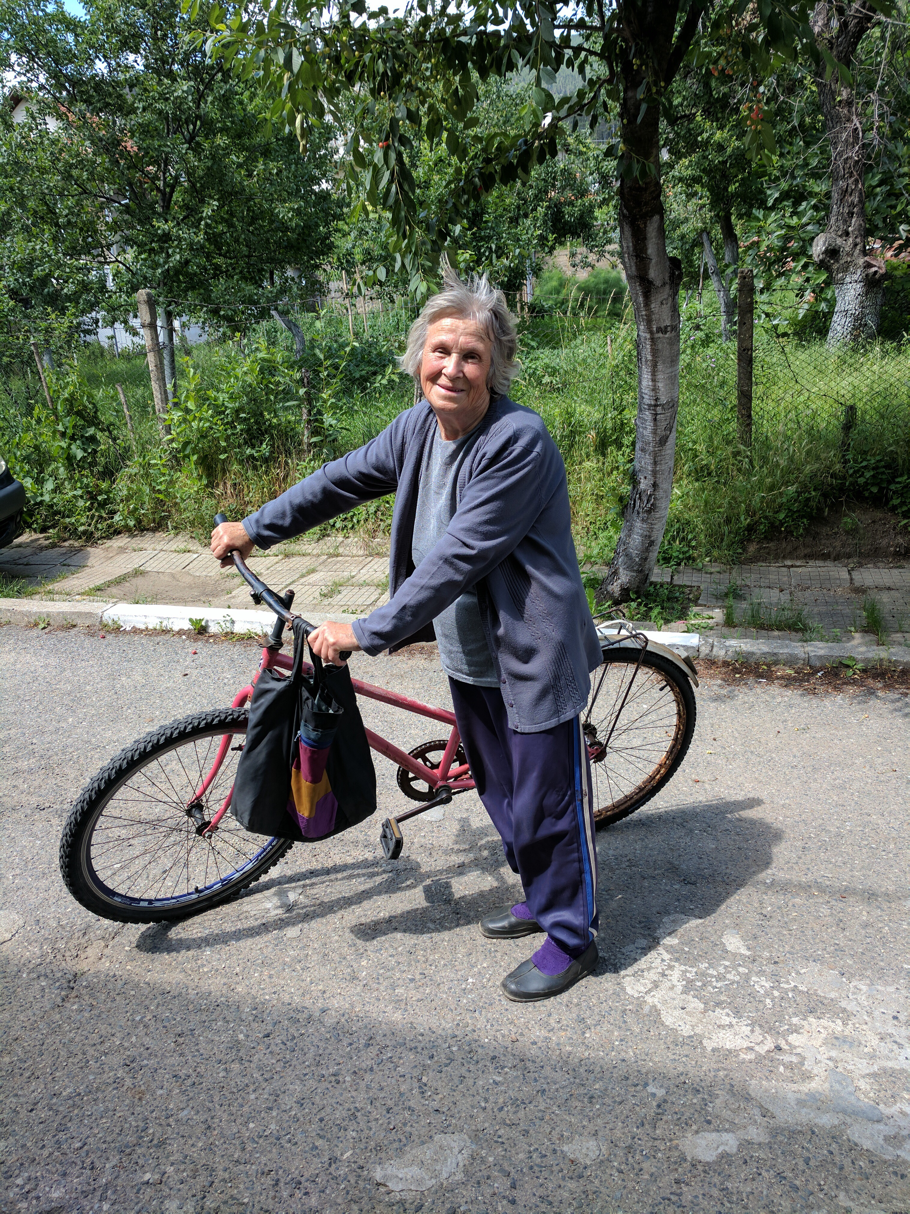
They were friendly and interested in me once I broke a little barrier by being interested in them. They were always kind and helpful (watching out of course for taxi drivers and politicians.) The above mentioned museum guard asked me to sit down as we chatted about child rearing and brought me a cup of tea with biscuits. People on the train offer food. I’m always directed to the WC whether I buy anything in the café or not. I’m shown where to get compression stockings by the pharmacist who walks me part-way down the street.

Does this culture of helpfulness come from child rearing? I have to surmise from a distance. Children are few and are beloved. Proud parents parade prams in the park. There are playgrounds whenever possible as part of a restaurant. Parents tolerate children freely yelling in a tomb (why not – it reverberates) or interrupting an adult conversation. The children seem happy and the parents happy with them – I have never seen an angry parent here. The children dance wth their parents the horo or imitate the steps to the side. The teens sit in the parks at night, just hanging out in a healthy way. Indeed people seem to sit a lot in cafes for coffee or beer or to socialize. It feels communal and healthy.Teens talk to strangers on the train with no self-consciousness or sullenness. Wow!
I wish them a better time ahead and sincerely hope they don’t lose the sense of community, family life and certainly nature as they move more into financial security. And I leave, so much richer, and well-fed, for the experience.

Thank you Bulgaria!